


Bath | 07.10.2026 | News
What our Leaderboard data says about the Specialized brand as Mike Sinyard retakes the reins

By Doug Baker, Chief Strategy Officer at SHIFT Active Media
In September 2026, Specialized announced that founder Mike Sinyard would return as Chief Executive Officer from the 1st November. This follows the successive two-year tenures of Scott Maguire (appointed March 2022) and Armin Landgraf (appointed May 2024) attempting to fill the founder’s shoes as CEO.
The announcement has reignited debate at industry events, bike shop floors and digital forums. What does the return of a legendary founder mean for the world’s most famous bike brand? With so many opinions, we wanted to take an objective, data-backed perspective on the status of the Specialized brand as Sinyard starts his next (unexpected) chapter.
To do this, we have pulled the numbers from Leaderboard, our brand equity tracker and Share of Search monitoring platform for brands in the cycling industry. The data focuses on road, gravel and Mountain Bike owners and covers North America, UK, Germany, Italy, Spain and France.
Full disclosure - whilst I own (and occasionally inexpertly race) a Specialized Crux and own some comfortable (and old) Torch road shoes - SHIFT Active Media has no formal commercial relationship with Specialized and this analysis is not based on any internal data from Specialized.
Unprecedented Breadth, a double edged sword
Across our Leaderboard platform, we track 166 cycling brands across 11 distinct product categories and Specialized stands apart as competing most actively across the most complete range of product categories, riding disciplines, markets and price points.
This scale offers some clear strategic benefits. The portfolio halo of high-profile flagship launches (such as an S-Works Tarmac or Levo) creates consideration spillover into peripheral categories like shoes, helmets and saddles. Frequent campaigns and broad distribution across different categories also ensures that Specialized remains visible and front of mind for the majority of enthusiast riders.
However, that same breadth creates a structural vulnerability. By competing everywhere, Specialized is continually exposed to more focused, specialist brands that target specific categories, regions or price points. In a post-pandemic landscape that has rewarded agility over scale, this has been a significant challenge for Specialized.
Complete Bikes - the end of unchallenged leadership
In the boom years surrounding the pandemic, Specialized enjoyed a significant lead in both search volume and brand equity. And whilst the Specialized brand retains significant equity, our data shows a dwindling leadership in the core complete bike categories.
Brand equity in complete bikes
Whilst Specialized remains the most recognized brand name overall, unprompted recall in road, gravel, and mountain biking has trended steadily downward, particularly in North America.
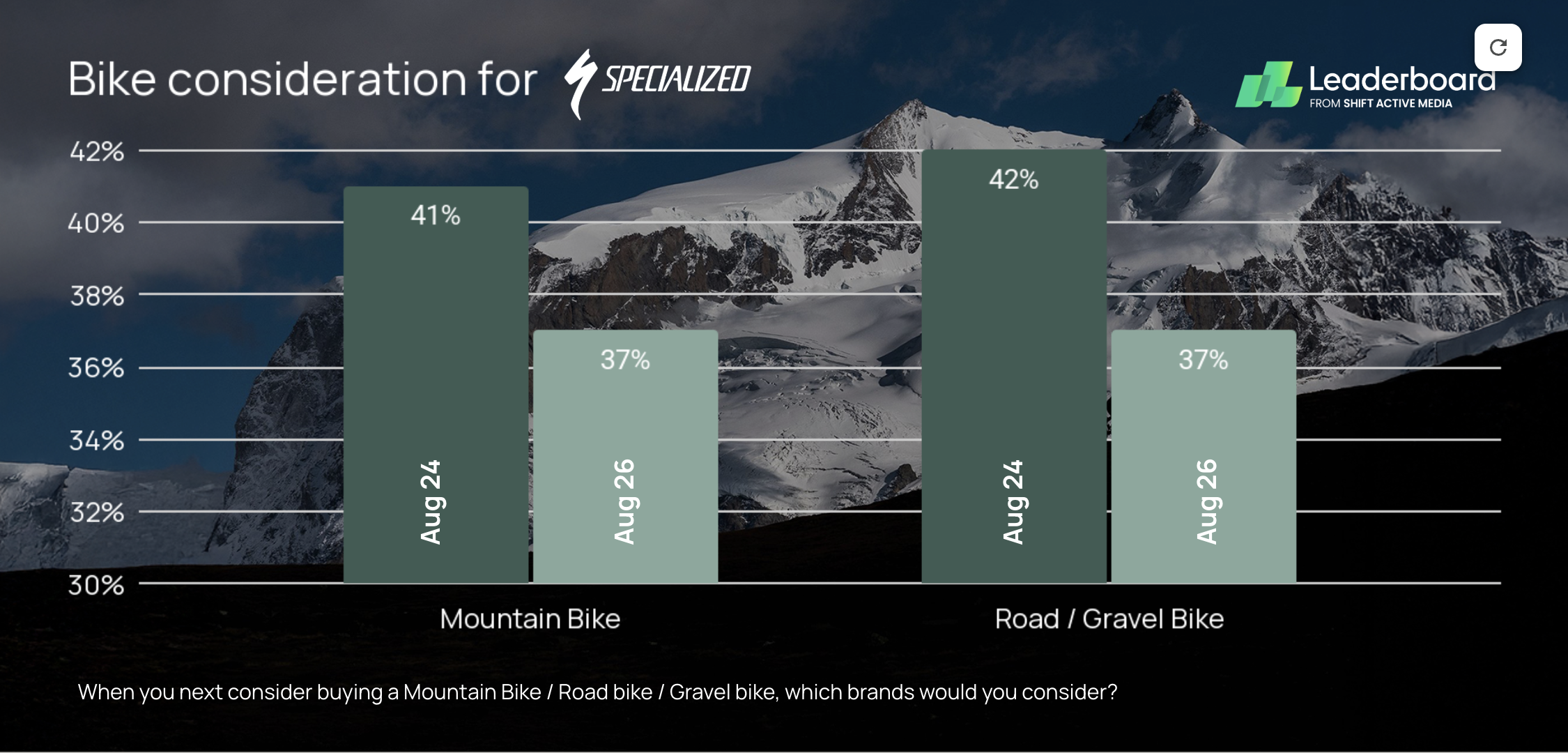
We are also seeing a steady but consistent erosion of brand consideration for rider’s next purchase. In MTB, consideration fell from 41% in August 2024 to 37% in August 2026, just about holding on to the top spot globally.
Meanwhile, in road and gravel bikes, consideration slipped by a similar amount, but owing to Canyon’s relative stability, Specialized has now conceded combined marked consideration to Canyon and now sits as the 2nd most considered brand. A large part of the decline comes from softening brand equity in their home market of North America.
Interestingly Specialized’s desirability score - the ‘money no object’ preferred brand - has stayed flat here. Suggesting the S-Works brand is potentially more insulated than the brand as a whole.
Share of Search for bikes
When we look at digital interest, measured by the relative share of searches for bikes in our key markets, we see this pattern of Specialized ceding ground to Canyon again. Specialized’s Share of Search (SoS) dropped from a peak of around 16.0% in May 2021 to 10.5% in August 2026. Whilst in the same period Canyon have sustained consistent presence and now hold a clear lead in online searches. Interestingly, search has been more resilient in North America, perhaps held up by frequent discounting (which can drive digital interest, without building brand equity).
Equipment Erosion: Slipping at High-Margin Contact Points
Beyond framesets, Specialized’s Body Geometry approach and associated innovations have been part of maintaining a much stronger presence in shoes and saddles. However, Leaderboard data also highlights growing pressure in these accessory segments from more focused specialists.
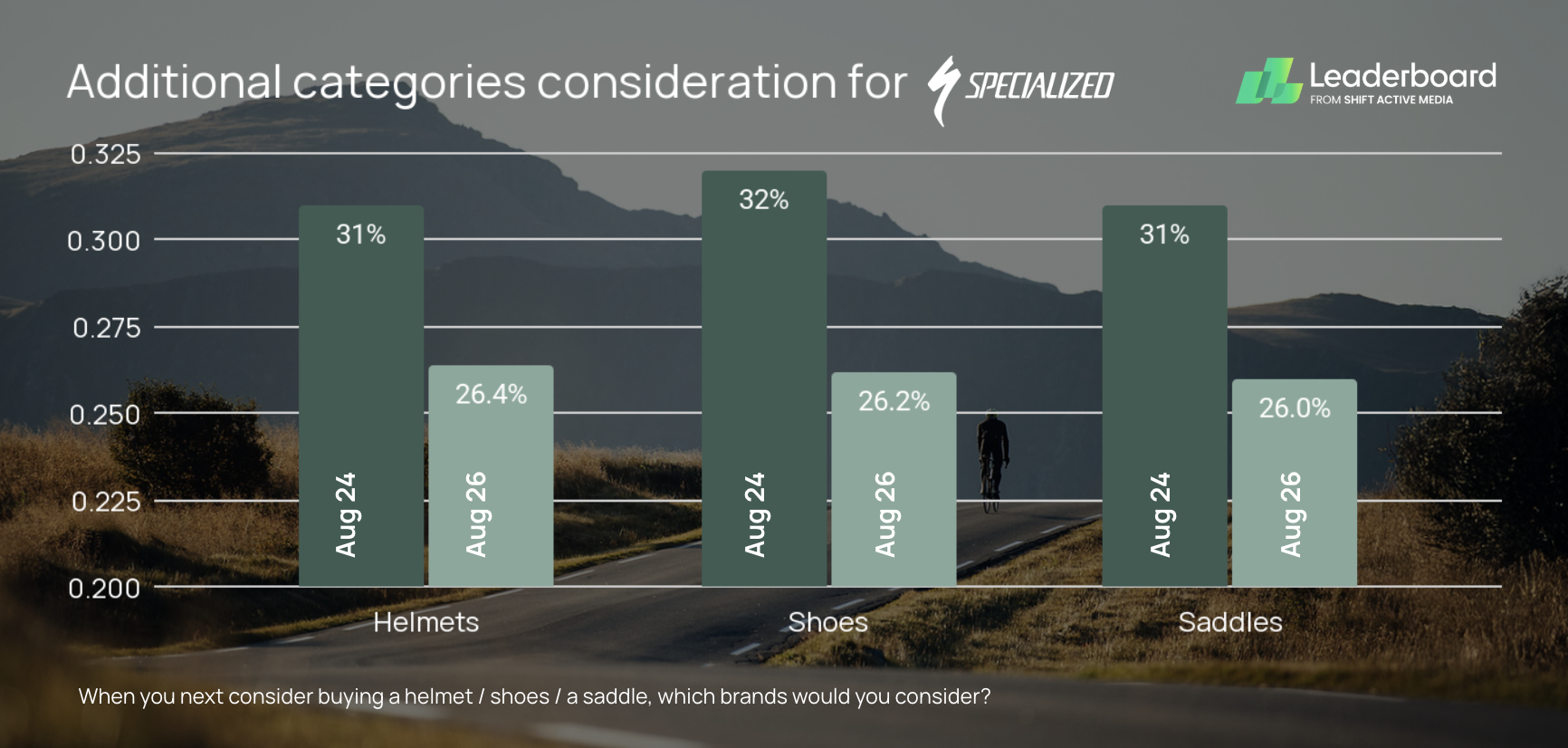
Between August 2024 and August 2026, unaided awareness for Specialized helmets dropped from 34% to 28%, consideration fell from 31% to 26% under pressure from brands like Giro and POC. Footwear saw a similar drop, with road and European markets the biggest challenges.
Meanwhile - long a category leader in saddles - we saw a similar pattern dropped across all core indicators. Unaided awareness fell from 30% to 25%, consideration dropped from 31% to 26%.
However, we do see that shoe desirability remained stable overall, again pointing to S-Work’s ability to retain desirability as a wider category is challenged.
Finally, Specialized has never been in the same leading position in wheels or tires, but they have been able to remain stable as around the 7th to 9th brand across markets and metrics.
The Strategic Crossroads for Mike Sinyard
So what is Mike Sinyard inheriting as the returning leader of the Specialized brand?
For me, the biggest takeaway - for those managing Specialized or a competitor - is that despite two plus years of decline in most categories, Specialized STILL remains a top-tier contender in most categories and markets that we track. It reinforces that brand equity is not just an asset that takes time to build, but it is also an asset that is resilient to short term issues and challenges. Decades of ambition and innovation, as well as market defining campaigns and era defining athletes have built a protective moat that is still - largely - intact.
However, Mike Sinyard returns at a critical juncture and Specialized finds itself squeezed between two forces. On one side are premium specialists with more focus and more agility in a still unpredictable market. On the other side are brands promising high-performance at better value than Specialized, from Canyon, to Van Rysel and perhaps even X-Lab and other Asian brands in the future. Incremental product improvements, and competent marketing won’t be enough to re-take the initiative.
And all of this is happening as technology continues to shift at pace, with Avinox powered bikes putting pressure on eBike product life cycles and AI disrupting working processes across all industries.
Get the next few years right, from a product and marketing perspective and Specialized has the scale and equity to rebound. Get it wrong and the current downward momentum will continue and fundamentally alter Specialized’s place in the cycling industry.
About Leaderboard
Leaderboard is SHIFT Active Media’s proprietary brand tracking service. Combining bi-annual consumer equity surveys across enthusiast cyclists with monthly Share of Search analytics, Leaderboard gives brands an affordable, cloud-based dashboard to monitor consideration, awareness, and competitive market dynamics.
To discuss our data services or book a demo, contact Doug at doug.baker@shiftactivemedia.com.
The latest news from SHIFT Active Media


